
The Research Behind Red Light Therapy
Red Light Therapy
After 40.
What does the research actually say about wrinkles, collagen, skin aging, hair density, joint function, recovery, sleep and healthy aging?
We went past the social-media claims and looked at randomized clinical trials, systematic reviews and dermatology research to find out.
Start With the Science
The real story is more interesting than the hype.
Red Light Therapy is often credited online with doing just about everything. That is exactly why it is worth separating what people say from what researchers have actually measured.
In scientific literature, you will often see the term photobiomodulation, or PBM. It refers to the use of specific wavelengths of red and/or near-infrared light to influence biological processes.
A major umbrella review published in 2025 examined 15 meta-analyses covering 204 randomized clinical trials and more than 9,000 participants. Researchers found statistically significant effects in several areas, but evidence quality varied substantially and none of the 35 outcomes reviewed reached high-certainty evidence.
In other words, there is real research here. There are also real limitations.
That is the approach we are taking in this article: no miracle language, no pretending every study proves the same thing, and no assuming that every red-light device produces the same result.
Skin After 40
Fine lines and wrinkles are among the most studied cosmetic uses.
If you are interested in Red Light Therapy because of visible aging, this is where the research becomes especially relevant.
A randomized clinical trial involving 137 women between ages 40 and 65 examined red and amber photobiomodulation for facial photoaging. Participants completed 10 sessions over four weeks.
Researchers objectively measured the volume of wrinkles around the eyes. They reported a reduction of approximately 31.6% on the red-light side and 29.9% on the amber-light side.
Randomized Clinical Trial
About a 30% reduction in measured wrinkle volume
The study involved 137 women ages 40 to 65 and used 660 nm red light and 590 nm amber light.
Researchers did not find improvement in every measurement, including hydration and viscoelasticity. That distinction matters.
A separate 2025 randomized, sham-controlled, double-blind study examined women ages 45 to 60 using 660 nm light.
Researchers found significant changes in certain wrinkle measurements made with computerized image analysis, while one clinical wrinkle-rating scale did not show a significant difference between treatment groups.
Collagen
This is not just a beauty-industry buzzword.
Collagen gives skin much of its structure. Changes in collagen and elastic tissue are part of the reason skin gradually becomes thinner, less firm and more visibly lined with age.
In a randomized, placebo-controlled, double-blind study involving 76 people with facial wrinkles, researchers tested 633 nm red light, 830 nm near-infrared light and combinations of the two.
Along with changes in wrinkles and elasticity, tissue analysis showed increased collagen and elastic fibers. Researchers also observed activated fibroblasts, the cells involved in producing important components of the skin’s structural matrix.
633 nm Human Research
Researchers measured more than appearance.
Investigators used photography, wrinkle measurements, skin-elasticity testing and tissue analysis to examine changes following treatment.
Another controlled clinical trial involving 136 volunteers examined red and near-infrared light treatment and used ultrasound to measure collagen density.
Treated participants showed improvements in skin complexion, skin feeling, objectively measured skin roughness and ultrasound-measured intradermal collagen density compared with controls.
Read the collagen-density study
The most accurate conclusion is not that red light “rebuilds your collagen.” It is that specific photobiomodulation protocols have produced measurable collagen-related changes in controlled human studies.
What This Means at Bradford
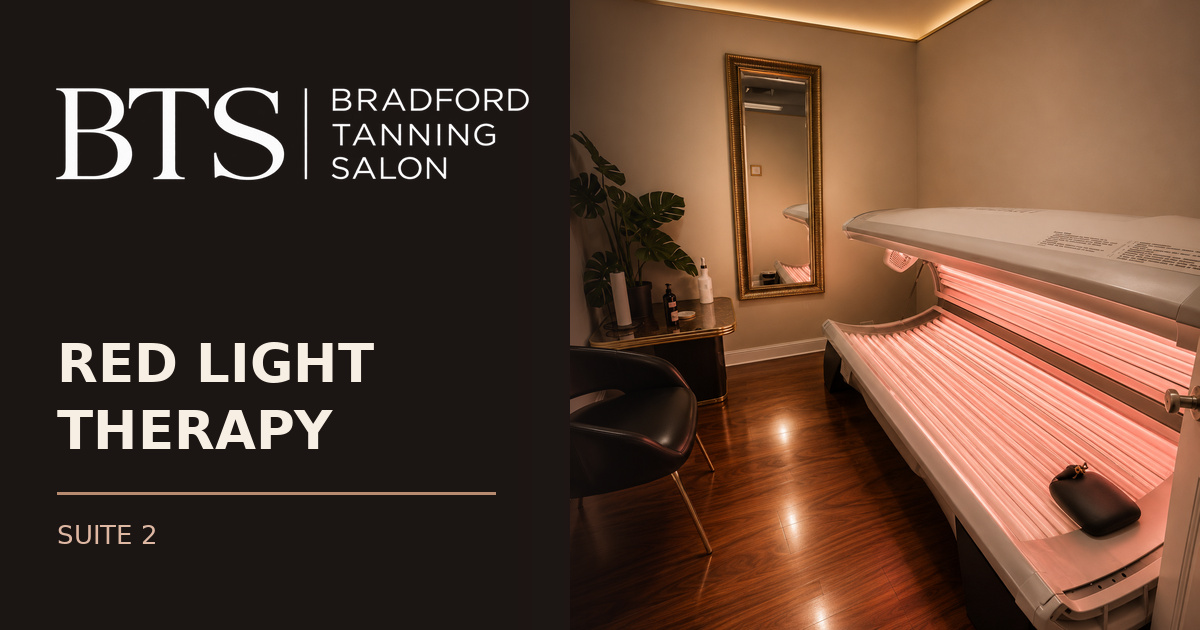
Our red-light system operates around 633 nm.
That number matters because 633 nm is not simply a marketing term. It is a red-light wavelength that has also been used in published human photobiomodulation research, including research examining facial wrinkles, elasticity, collagen and elastic fibers.
It does not mean every person will experience the same results seen in a clinical trial. Treatment dose, frequency, exposure area and individual biology still matter.
What it does mean is that the wavelength used during your Bradford Red Light Therapy session falls within the same area of red-light research that scientists have been studying for years.
Red-light studies have examined fine lines, wrinkles, skin texture, elasticity and collagen-related changes.
Rather than treating one tiny area at a time, your session provides comfortable full-body red-light exposure as part of a simple self-care routine.
Research protocols commonly involve repeated sessions. A comfortable, predictable appointment makes consistency much easier to build into your routine.
Hair Density
Hair thinning is another area with substantial research.
Changes in hair density become increasingly common with age, which makes this an understandable area of interest for both women and men.
A systematic review and meta-analysis examined 38 studies involving 3,098 people, most involving androgenetic alopecia, the common hereditary form of hair loss.
Researchers reported significant improvements in hair density with low-level laser or LED treatment compared with placebo in people with androgenetic alopecia.
Read the systematic review and meta-analysis
The larger 2025 umbrella review also found increased hair density in androgenetic alopecia and rated that outcome as having moderate-certainty evidence.
Important Distinction
Hair research often uses scalp-specific equipment.
These findings are interesting, but they should not automatically be assumed to apply to every full-body red-light system. Hair-loss studies frequently use devices specifically designed to deliver light directly to the scalp.
Movement & Mobility Research
What about joints, stiffness and mobility?
This is another reason photobiomodulation has attracted attention from researchers working with older populations.
A 2024 systematic review and meta-analysis examined 10 placebo-controlled studies involving 542 people with knee osteoarthritis.
The analysis found a reduction in pain at rest compared with placebo, although the certainty of evidence for that outcome was rated very low. Researchers also reported possible improvements in disability.
Their conclusion was appropriately cautious: photobiomodulation may be useful as a complement to established therapies, rather than a replacement for them.
Read the knee-osteoarthritis meta-analysis
Keep the Language Accurate
“Studied for osteoarthritis” is not the same as “treats arthritis.”
Medical conditions should be managed with qualified healthcare professionals. These studies tell us what researchers observed under particular treatment conditions.
Fatigue & Stiffness
Researchers are also studying physical function.
The 2025 umbrella review found statistically significant improvements in several measures among participants with fibromyalgia, including fatigue severity, stiffness and overall symptom scores.
The strength of the evidence varied depending on the specific outcome, and treatment protocols differed considerably across studies.
Emerging Research
Could photobiomodulation affect sleep?
This is interesting research, but it belongs firmly in the “promising and still developing” category.
A 2026 systematic review and meta-analysis examined five randomized controlled trials involving 240 participants.
The pooled analysis found improvement in Pittsburgh Sleep Quality Index scores compared with sham treatment. However, researchers cautioned that the evidence remained limited and imprecise.
Read the 2026 sleep meta-analysis
Research Status
Interesting? Yes. Settled science? Not yet.
“Research suggests” and “proven benefit” are not interchangeable phrases.
Put the Research in Perspective
Not every benefit belongs in the same bucket.
Some applications have more human evidence behind them than others.
Facial photoaging, wrinkles, collagen-related skin changes and androgenetic alopecia have multiple controlled human studies behind them.
Certain musculoskeletal outcomes, fatigue, stiffness and functional measures have shown positive results, although evidence strength varies.
Sleep and cognitive applications are particularly interesting, but protocol and equipment differences make broad conclusions premature.
The Most Important Caveat
Not all red light therapy is the same.
This may be the single most important thing to understand when reading photobiomodulation research.
A study showing a particular outcome does not prove that every red-light device will reproduce it.
Clinical studies can differ in virtually every part of the treatment protocol:
The 2025 umbrella review specifically identified substantial variation in photobiomodulation protocols and noted the lack of a single standardized protocol across conditions.
A Common Question
Is red light the same as UV light?
No. Red light and ultraviolet light occupy different parts of the electromagnetic spectrum and interact with tissue differently.
The American Academy of Dermatology describes Red Light Therapy as a non-invasive treatment using red or near-infrared light and distinguishes it from ultraviolet exposure.
The AAD notes that current research has not found red light to carry the same cancer risk associated with UV exposure, while also pointing out that long-term research remains more limited than short-term safety data.
Read the American Academy of Dermatology overview
A 2025 evidence-based consensus published in the Journal of the American Academy of Dermatology concluded that photobiomodulation is generally a safe treatment modality for adults and that red-light PBM does not induce DNA damage under the conditions reviewed.
Safety Matters
Non-invasive does not mean “ignore precautions.”
Short-term Red Light Therapy is generally described as well tolerated, but individual circumstances still matter.
Two randomized dose-escalation safety trials involving 115 healthy participants studied relatively high doses of LED red light. No serious adverse events occurred.
Mild temporary redness and hyperpigmentation were reported, while very high doses produced occasional blistering or prolonged redness.
Read the randomized safety trials
Speak with a healthcare professional first if:
- You have a condition that causes unusual sensitivity to light.
- You take medication known to increase photosensitivity.
- You are being treated for a medical condition and want to use photobiomodulation specifically for that condition.
- You are unsure whether light exposure is appropriate for you.
Always follow the safety instructions for the specific equipment being used.
So What Does All This Mean?
You can be interested without believing the hype.
That may actually be the most reasonable position to take.
Photobiomodulation is not a fringe subject with no scientific literature behind it. Researchers around the world have studied it in randomized clinical trials, controlled trials, systematic reviews and meta-analyses.
There are particularly interesting findings involving visible skin aging, wrinkles, collagen-related measures and hair density.
Other areas, including musculoskeletal function, fatigue, sleep and cognition, continue to be actively studied.
At the same time, there is no good scientific reason to pretend every result is proven, every protocol is equal or every person will experience the same outcome.
The research is interesting enough without exaggerating it.
Read the Research Yourself
Studies & sources.
We do not expect you to simply take our word for it. Below are the studies, reviews and professional medical sources referenced throughout this article.
Bradford Tanning Salon
Make Red Light Therapy part of your self-care routine.
Whether your interest is skin aging, collagen-related research, wellness or simply making time for yourself, our full-body Red Light Therapy experience makes it easy to build a consistent routine.
Planning your visit?
Book your appointment online at least 48 hours in advance.
For same-day or next-day availability, call us at
(978) 373-9201.
Research & wellness disclaimer: This article is provided for educational purposes and summarizes published research involving photobiomodulation. Bradford Tanning Salon offers Red Light Therapy as a wellness and self-care service and does not diagnose, treat, cure or prevent medical conditions. Results reported in individual clinical studies involved specific equipment, wavelengths, doses and treatment protocols and should not be interpreted as guaranteed outcomes from any particular Red Light Therapy session or device. If you have a medical condition, take photosensitizing medication or are considering photobiomodulation for a specific medical concern, speak with a qualified healthcare professional.